
Crafting: Dwarven Smithing
The craft of the Artisan and Warsmith
The Dwarven crafter's main skill is Create Item: with it a Dwarf creates items from recipes. After becoming an Artisan, the Dwarf - now a full-fledged crafter - gets another skill, Crystallize, which "breaks" items of any grade into crystals of the matching grade.
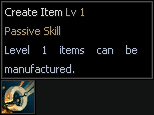
Recipes and the recipe book
Monsters drop all kinds of recipes. Only Dwarves can use them: a recipe teaches how to make a particular item. But to create an item from a recipe, you must first register it in your recipe book.
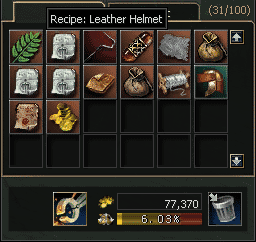
To register a recipe, double-click it with the left mouse button and confirm. The recipe disappears from your inventory and appears in the book. This cannot be undone: you cannot take a recipe back out of the book to give it to someone else.
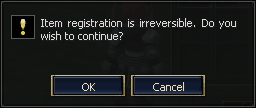
A registered recipe can never be taken out again.
The recipe book opens with the Create Item icon in the inventory window. It shows the recipes you have learned and how much free space is left. The book holds no more than 50 recipes - to register a new one, you have to delete old ones.
Do not register recipes you do not need or cannot use. Recipes come in different difficulty levels, and the Dwarf must have Create Item of the same level or higher.
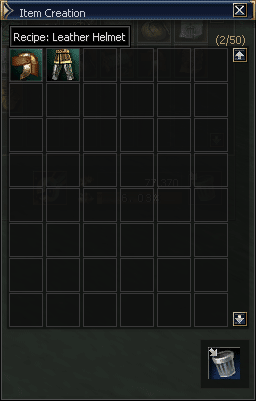
The recipe book - not many entries yet, but that's a matter of time.
The item creation window
Double-clicking a recipe in the book opens the item creation window. The top part shows the required MP, the number of items produced per craft and the success rate.
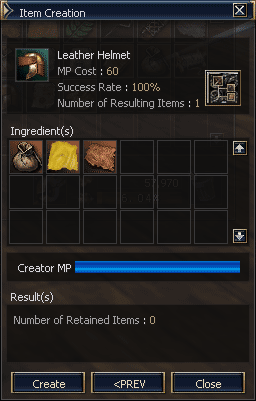
The middle of the window lists the required materials. A grayed-out material means you do not have enough of it. The button in the upper right opens the craft tree - indispensable for complex recipes.
The craft tree
In the craft tree, the icon of the item being made has a "+" sign: click it to see what materials the item is made from. Why, if the creation window shows the same thing? Because of material types.
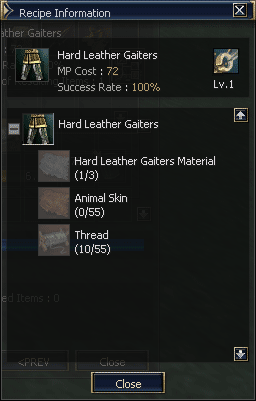
There are 2 types of materials:
- Basic - resources obtained only from monsters (by spoiling), from some quests, and as rewards for crops handed in through the manor system.
- Intermediate - obtained the same ways, but they can also be crafted from a recipe.
Any self-respecting crafter should have all the intermediate material recipes, and there are quite a few. Keep in mind that the book is already short on space, and with intermediate recipes there will be even less room for item recipes.
High-difficulty item recipes need both basic and intermediate materials. If the recipes for the required intermediate materials are in your book, their icons in the craft tree also get a "+". This lets you see the whole crafting chain - that is the point of the tree. Double-clicking an intermediate material marked "+" opens its creation window, where you can make as much of it as you need.
Creating an item
When you have all the materials, press CREATE: the materials disappear from your inventory and the item appears in their place.
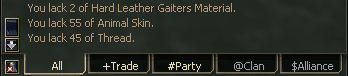
Not quite enough...
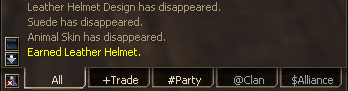
...and now it's just right.
The craft window stays open after creation: you can keep pressing CREATE until you run out of materials or MP, or have made as many items as you need. The bottom of the window shows how many items you have made; closing and reopening the window resets the counter.
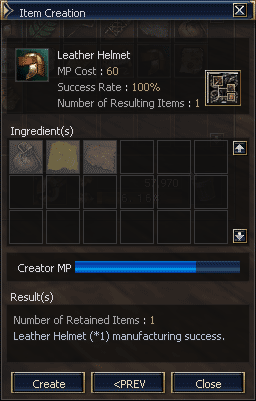
This attempt succeeded - no surprise, it is a level 1 recipe.
The same window reports whether the attempt succeeded. A high-difficulty recipe does not always work; the success rate is always shown in the recipe. On failure the Dwarf loses all the materials used in the attempt.
Crystals and Crystallize
To create items of a given grade you need crystals of the same grade and gemstones. Gemstones are sold only in shops. Crystals can only be obtained by "breaking" an item of the same grade.
To break an item, drag it onto the Crystallize skill icon in the inventory and confirm. A pile of crystals appears in place of the item.
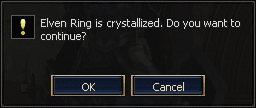
Different items give different numbers of crystals. Weapons give the most; breaking armor is not profitable. The required Crystallize level depends on the item grade:
| Item grade | Crystallize level |
|---|---|
| D | 1 |
| C | 2 |
| B | 3 |
| A | 4 |
| S | 5 |
Low-quality and high-quality items
So where do you get, say, B-grade crystals if B-grade items cannot be obtained? All items fall into 2 types:
- High-quality - require crystals of the same grade as the item; these are usually the best items of their grade.
- Low-quality - require crystals of a lower grade; these have the worst stats in their grade.
After making a low-quality item, you can break it into crystals and then make a high-quality item.
Another way is dual swords. Combining 2 particular swords of one grade gives dual swords one grade higher; this is the easiest way to get crystals. And although weapons give more crystals, armor is sold second-hand more often, and weapon prices can be inflated.
Crystal cost
Whichever method you choose, always calculate the cost of the crystals you get. You can work out how many crystals an item gives from its base price and the base crystal price:
| Grade | Base crystal price |
|---|---|
| D | 550a |
| C | 2,500a |
| B | 7,500a |
| A | 12,500a |
| S | 20,000a |
Don't even think of selling crystals at base prices - you'll go broke. You can find an item's base price in any shop: NPCs always offer half its base value. Divide the item's base price by the base price of a crystal of the same grade to get the number of crystals the item yields.
Experienced crafters recommend these crystal sources:
- D - armor and weapons bought from other players.
- C - dual swords: check the weapon table for which D-grade swords combine into C-grade dual swords.
- B - mostly low-quality B-grade items, since B-grade weapons cost a fortune.
- A - can be bought for ancient adena from the Trader of Mammon in the Seven Signs dungeons.
Crystals for summoning
Crystals are needed not only for crafting but also for summoning creatures - by Dwarves themselves and by mages. This can be a nice business: buy items cheaper and sell crystals at a higher price.
- Most summons need a few D-grade crystals; summoners need them especially, and usually in large quantities.
- Summoning a siege golem requires C-grade crystals.
- Castle lords need B-grade crystals: summoning a war dragon costs quite a few of them.
SoulShots and SpiritShots
Crystals are also used to make weapon boosters, commonly called "shots" - SoulShot, SpiritShot and Blessed SpiritShot. They increase a weapon's physical or magic damage at the moment of attack. Each attack uses a certain number of shots depending on the weapon, and each weapon grade needs shots of the same grade.
During intensive leveling shot consumption is very high, so demand is constantly strong. Shot recipes are hard to get and sometimes cost a fortune. But sooner or later they not only pay for themselves but bring a steady income.
Besides crystals, production requires special materials: Soul Ore for SoulShots and Spirit Ore for SpiritShots and Blessed SpiritShots. One craft usually takes a few crystals and several dozen Soul or Spirit Ore, and yields many shots at once - the exact number is shown in the recipe.
A Dwarf's main weapon is the art of bargaining: buy low and sell high. Go for it!
Additional notes
From the article "The Power of Dwarves" (l2db.ru, author Mandrayk).
Income and demand
- A good fighter earns 100-400 thousand adena a day on grueling hunts, while a Dwarven crafter earns 100-700 thousand without leaving the spot.
- Only crafters can create "ammo" (shots) for weapons from D-grade upward. On a good hunting session a mage uses 2-3 thousand shots and a fighter around 10 thousand. There are always fewer Dwarves than members of other races, so demand for shots is stable - they are worth crafting constantly.
- Gatherers (Scavenger, Bounty Hunter) supply crafters with materials: some resources can only be obtained with Spoil, and the rest drop from monsters rarely and irregularly. Selling resources is their only way of earning.
What to craft and what not
- Many items are simply unprofitable to craft: they eat lots of expensive resources (especially C-grade and above). Before clicking Create, compare the cost of the resources with the expected sale price.
- Items that cannot be bought in shops sell best - above all, armor set pieces. Even in D-grade, at least one item from each set is missing from shop shelves. For example, Brigantine, Brigantine Gaiters and a Brigantine Helmet together give extra HP, +5% P. Def and so on.
- D-grade: good demand for Brigantine Helmet, Brigantine Shield, Elven Mithril Gloves, Manticore Skin Boots and others.
- C-grade: almost any helmet (they are not sold in the Luxury Store), Karmian Gloves, Composite Shield, Full Plate Helmet, Full Plate Armor, Full Plate Boots.
- B-grade: the Avadon, Zubei, Doom and Blue Wolf sets.
Resources
- Universal resources go into many recipes in large quantities: Animal Skin, Cokes, Cord, Varnish, Iron Ore, Silver Nugget, Stem and others. Special resources are used only for a specific item: Composite Shield Fragment, Brigantine Helmet Design and others.
- A sample chain: Leather is made from 6 Animal Skin, Crafted Leather from 4 Leather. Some complex resources drop from monsters, but many can only be crafted (Silver Mold, Artisan's Frame).
- The best-selling resources: first Animal Skin, Leather and Crafted Leather - a Dwarf should buy them up for processing and stockpiling. Next come Coal (also needed for Crafted Leather), Cokes, Mithril Ore, Oriharukan Ore, Steel, Stone of Purity, Iron Ore.
- Neither crafted nor spoiled: Soul Ore and Spirit Ore, Gemstone D, C, B (sold in the magic shop), and crystals D, C, B (obtained by crystallizing items of that grade).
Recipes
- Many recipes need not even be read - just sell them to a shop. For a valuable recipe, first check the required resources: equipment always needs special resources (find out at once from whom and how to get them), universal ones, and sometimes crystals and gemstones.
- Some recipes (mostly B-grade) disappear after use. A failed craft destroys the resources spent.
- Some recipes come in two variants (Manufacturing Process): one needs fewer resources but is riskier, the other is more reliable but needs far more resources.
- First of all you need recipes for universal materials: Leather, Steel, Cord, Coarse Bone Powder, High Grade Suede, Braided Hemp, Compound Braid, Varnish of Purity, Cokes, Steel Mold, Silver Mold, Mithril Alloy, Synthetic Cokes, Blacksmith's Frame, Artisan's Frame and others. Then the SoulShot and Blessed SpiritShot recipes for all grades available to you, and recipes for set items (Manticore Skin Boots, Brigantine Helmet, Brigantine Shield, Mithril Boots, Composite Shield and others).
- Recipes for simple materials drop from (or are spoiled from) weak monsters. Once your level is higher than theirs, these recipes stop dropping, and you will have to buy them from younger Dwarves.
Crystals
- Crystallizing items unlocks with the Dwarf's level: D-grade at level 20, C-grade at 40, B-grade at 52.
- A second, "accidental" source of crystals is a failed enchant. If an attempt to enchant an item above +3 with Enchant Armor or Enchant Weapon fails, the item breaks into crystals of its grade.
- It is more profitable to crystallize more expensive items of a grade: their price-to-crystal ratio is better.
- Crystal prices differ across the regions of Aden depending on taxes (for example, after a castle is taken) - this matters when buying or selling large batches.
- C-grade crystals: buy two D-grade swords, combine them into a dual and crystallize it. The most profitable pair is Sword of Revolution + Sword of Revolution: the crystals come out cheaper than from a Sword of Revolution + Saber pair, and cheaper still if you buy the swords from players.
- B-grade crystals: gather a large batch of D-grade crystals, get C-grade crystals using the scheme above, then buy two C-grade swords in the Giran Luxury Store, for example Stormbringer and Delusion Sword, combine them at the blacksmith and crystallize at once. You get over 900 B-grade crystals. The cost in crystals: 1,648 C and 8,230 D.
Where to trade
A good trading spot is any crowded square. Exactly where to sit depends on your pricing:
- Same prices as competitors. Sit so that buyers reach you last: after walking past everyone and seeing that prices are the same, a buyer will buy from you - they will not walk back.
- Lower prices than competitors. Sit in the most visible spot so buyers cannot miss you: after studying the other prices, they will surely come back. But undercutting angers other Dwarves: they must either wait for you to leave or undercut you, losing money either way. You respond in kind, and the price slowly but surely creeps down. Buyers quickly get used to low prices, and raising them again takes coordinated action by all the traders.