Killing Floor (2009) Fact Sheet: Credits, Release, Requirements
A compact reference card for the original Killing Floor: who made it, when it came out, where it runs and what hardware it needs. It is the kind of data store and catalog pages list, collected in one place with some context. For a gameplay-focused introduction see Killing Floor 1 or about the game.
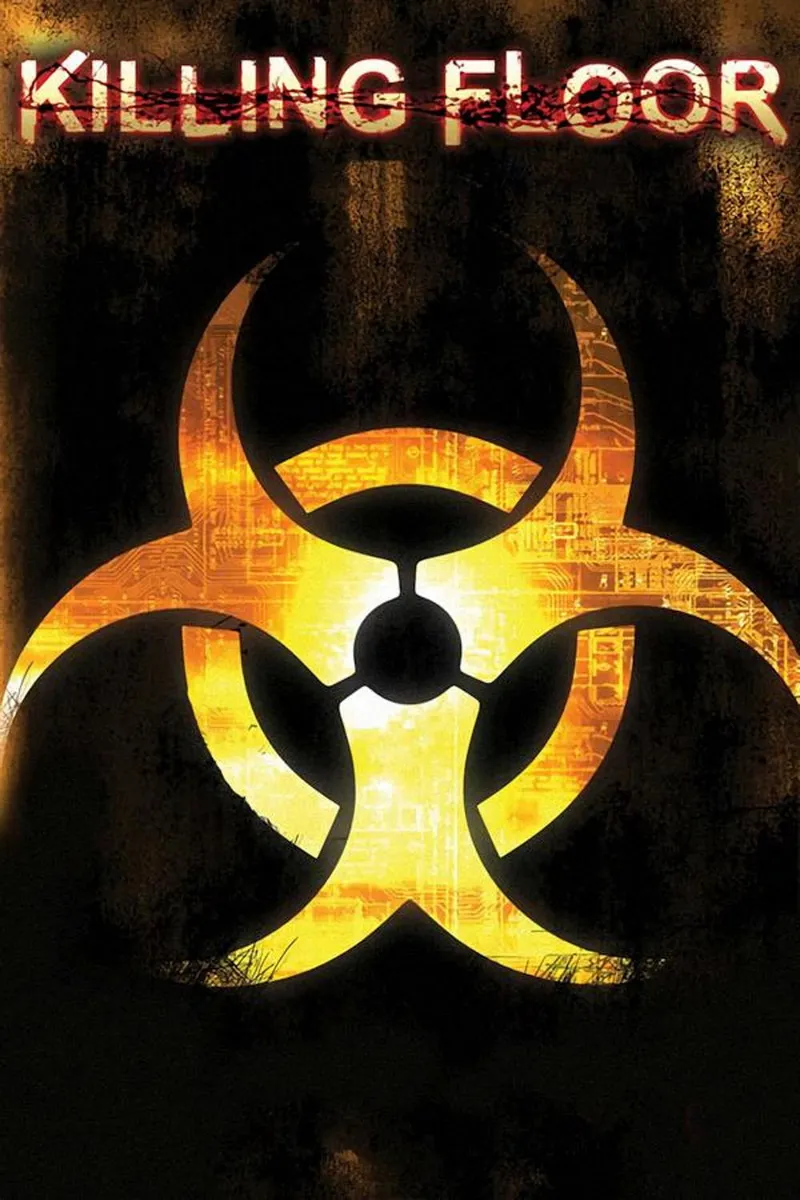 Killing Floor (2009) cover art: the biohazard symbol that became the series' emblem.
Key facts
| Field | Value |
|---|---|
| Title | Killing Floor |
| Release date | 14 May 2009 (Windows) |
| Developer | Tripwire Interactive |
| Publisher | Tripwire Interactive |
| Director | Alex Quick |
| Writers | Dan Nassick, Alex Quick |
| Music | zYnthetic, Dirge |
| Genre | First-person shooter (co-op survival) |
| Modes | Single-player, multiplayer |
| Platforms | Windows, macOS, Linux |
| DLC | Yes (characters and weapon packs) |
| Age rating | 18+ |
| Critic score | 72/100 (Windows) |
The people behind it
Alex Quick is the name most tied to Killing Floor. He started it as a total-conversion mod for Unreal Tournament 2004 (released in 2005), and Tripwire Interactive, the studio behind Red Orchestra, worked with him to turn it into a standalone retail game. He is credited as director and co-writer.
Dan Nassick shares the writing credit. The story is deliberately thin: a biotech company, Horzine, loses control of its cloned specimens in London, and a small squad has to clean up. Background reading: Horzine Corporation lore and history of the creation of Killing Floor.
zYnthetic and Dirge are credited with the music. The industrial metal and dark electronic tracks between waves, and the heavier music during boss fights, are a big part of the game's identity. More in soundtrack and audio design.
Release timeline
| Platform | Release |
|---|---|
| Windows | 14 May 2009 |
| macOS | May 2010 |
| Linux | November 2012 |
The game runs on Unreal Engine 2.5 and requires Steam on every platform. The macOS build is 32-bit only, so it does not run on macOS Catalina (10.15) or later. For years after launch Tripwire kept adding free content (new maps, the Firebug perk, seasonal events) alongside paid character and weapon packs. See patch history and DLC overview.
System requirements (Windows)
| Minimum | Recommended | |
|---|---|---|
| OS | Windows XP or newer | Windows XP or newer |
| Memory | 1 GB | 2 GB |
| Storage | 2 GB | 2 GB |
Any PC from the last decade clears these easily. Modern problems with KF1 are about compatibility rather than performance: alt-tab, high refresh rates, the default FPS cap and widescreen settings. Check graphics settings optimization and startup crash on Windows 10 if something misbehaves.
Modes at a glance
- Single-player: solo survival against the same wave structure, useful for learning maps and testing loadouts.
- Multiplayer: co-op for up to 6 players by default, on official or community servers. Community servers often raise the player cap with mutators.
- Objective mode was added later as a variant with map-specific tasks: see objective mode walkthrough.
Each match is a set of waves (short, medium or long) of specimens, with a trader break between waves and a final fight with the Patriarch. Players pick a perk such as Field Medic, Support Specialist, Sharpshooter, Commando, Berserker, Firebug or Demolitions and level it through perk-specific tasks.
Reception
The Windows version holds a critic score of 72/100. Reviews at launch praised the co-op tension, the specimen design and the low price, and criticized the dated visuals and limited content at release. The community kept the game alive for years through custom maps and servers, and its success funded Killing Floor 2. See reviews and ratings for more.
FAQ
- When was Killing Floor released?
- The retail Windows version came out on 14 May 2009. The macOS version followed in May 2010 and the Linux version in November 2012.
- Who directed Killing Floor?
- Alex Quick, who also created the original Unreal Tournament 2004 mod. He co-wrote the game with Dan Nassick.
- Who composed the Killing Floor soundtrack?
- The game's music is credited to zYnthetic and Dirge.
- What PC do I need for Killing Floor 1?
- Very little by modern standards: Windows XP or newer, 1 GB RAM (2 GB recommended) and about 2 GB of storage.