KF2 Fast Classes: Medic and Berserker Skills, Weapons and Running
This guide (written for the era of the reworked perks, mostly for Hell on Earth and Suicidal public games) covers the two fast, self-sustained perks: Field Medic and Berserker. It does not teach basics, but assumes you want to improve.
Both perks are faster than most others and, unlike the third fast perk (Gunslinger), strongly self-sufficient: survival skills, speed to outrun threats and quick ways to restore health on the move. They are also the backbone of team compositions: Medic as the main healer, Berserker as the sturdy target for even the largest zeds. And neither struggles with any zed type.
Field Medic
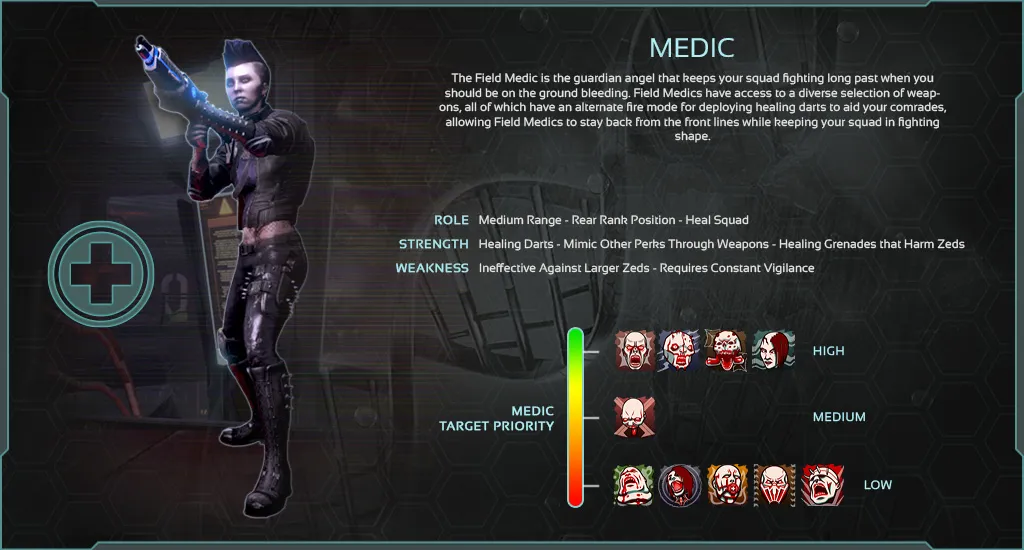
Field Medic.
Playstyle ranges from a dedicated healer and buffer to a full damage dealer who also keeps allies alive between shots. Skills decide which role fits.
Skills
- Symbiotic Health vs Resilience: Symbiotic Health heals you while a damaged ally is nearby and raises max health, which improves survival against fast deaths. The author prefers it in most situations, even solo. Resilience is situational: a second Medic on the team, boss fights or the corner stand below.
- Adrenaline Shot vs Combatant Doctor: Combatant Doctor makes you fast; take it. Adrenaline Shot is arguably useful only in duo runs.
- Focus Injection vs Acidic Rounds: neither is vital. Injection is hard to use well; acid can make trash zeds panic and body-block their own horde.
- Coagulant Booster vs Battle Surgeon: a choice between making an ally nearly one-shot-proof and being able to protect yourself and perform as last man standing. Take Battle Surgeon if you do not expect good tank-teammates cooperation.
- Airborne Agent vs Zedative: Agent gives extra self-sustain and random heals, but the cloud shakes screens, which annoys aiming teammates. Zedative slows a large zed so it cannot chase you or reach its target, though its damage is unreliable.
Weapons
- Medic rifle (SMG-like, 9mm): very hard recoil, so aim down sights, crouch when starting, and fire in separate clicks. Best for fast chained headshots on trash; best healing and dart capacity.
- Medic shotgun: low damage and strong falloff, but high semi-auto speed and devastating point-blank headshots; can kill a Siren in one headshot with the damage skill. Heals less per dart. Heal with it if you may need to shoot any second.
- Medic pistol: starting item, heals little, only two dart uses, but precise shots kill trash and its shove is one of the best. Do not use it on Bloats (use the Beretta).
- Medic SMG: an optional early purchase with little value; use it only if you cannot aim or in late waves when you lack money.
Tips
- Priorities: heal teammates and attack what attacks you; then trash hitting teammates and Sirens; then focus fire on large zeds or kill distant trash.
- Do not aggro faraway Scrakes or Fleshpounds, go rambo, or block line of sight and retreat paths.
- Darts are heat-seeking at injured teammates and can curve slightly around obstacles but not through them. Zed Time and sprint-shooting make them go straight; aiming down sights improves the curve.
- Buffs do not apply properly to fully healed allies; grenades seem to stack buffs once per ally.
- Your syringe is shortened by your perk cooldown reduction.
- If a Fleshpound enrages, a knife parry can reduce its attack.
- Once you can afford a serious weapon, throw your Medic pistol to a Berserker, Commando, Support, Gunslinger or flamethrower Firebug who has spare weight. Fill your last weight with dual Berettas.
- If boxed in, find a corner where only one large zed can reach you, throw a grenade at your feet, pull the shotgun, back to the wall and take them one at a time. It is surprisingly effective but running away is better if possible.
Berserker
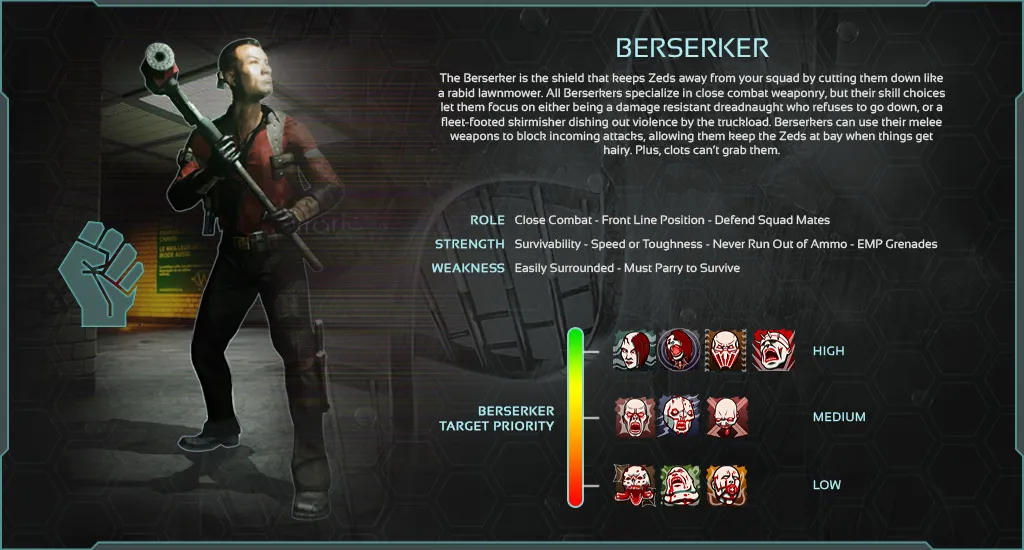
Berserker.
The author considers the Berserker rework precise: passive health regeneration, damage mitigation through skill (parry) and lots of damage for large zeds. Berserker is high risk, high reward solo and a self-sufficient team member. The mindset: act suicidally brave while calculating ten steps ahead.
Skills
- Dreadnaught vs Skirmisher: Skirmisher makes you fast and self-sustained. Dreadnaught suits holding a choke point but does not fit this guide.
- Vampire vs Butcher: Vampire shines only when the team has no Medic, and it hurts a Medic's Symbiotic Health. Butcher works best when you have a Medic or are last man standing. Vampire does not stack with normal healing.
- Resistance vs Parry: Resistance mitigates most damage while you tunnel on a target, helps against surprise one-shots and being boxed in. Parry is great skill-based tooling but cannot handle all trash. The author always prefers Resistance.
- Smash vs Massacre: Smash raises single-blow damage, can wipe a group in one swing and guarantees a stumble on a large zed if it has not stumbled recently. Massacre has little effect.
- Spartan vs Berserker Rage: the author says Spartan.
Attack directions
Movement direction when attacking changes the strike:
- Forward: overhead blow, sometimes followed by more swings. Highest damage, clear hitbox; best against large zeds.
- Sideways: medium-to-long range horizontal swings that hit most enemies in front of you; best for trash.
- Backward: short-to-medium range, more damage than horizontal but less than forward, with a poor hitbox. Easiest while backpedalling.
- Quick melee: a wide shove for blunt weapons and a thrust for sharp ones; low range, quick, with stumble power. Sharp weapons can headshot.
- Alt-fire: block (about a quarter to half of damage mitigated). Timed just before impact it becomes a parry, which avoids more than half of the damage and stumbles the zed. Attacks with a glowing red weapon cannot be parried.
Weapons
- Crovel: starting shovel and crowbar. Light attacks are weak, but heavy swings have excellent range and the best horizontal hitbox.
- Knife / Katana: light attacks control crowds, heavy ones are for single targets.
- Zweihander: slow but huge damage; kills most trash in one blow, can behead a Bloat from outside vomit range, and one Zed Time can cut apart a Scrake in a full team. Charge before approaching.
- Pulverizer: only for Fleshpounds and bosses; avoid in Zed Time because reloading is not sped up.
- Eviscerator: a saw launcher best against large zeds: a Scrake dies to about two headshots and a Fleshpound to three. Hard to aim and with slow projectiles, but it keeps your mobility.
- Nailgun: acts like a shotgun with ricochets, leaves you vulnerable; the author calls it a newbie or challenge weapon.
Berserker tips
- Be the public enemy number one for zeds and train as many large zeds as you can handle.
- Set sprint to toggle, switch it off for light combo fights or parrying, then back on.
- Against blocking enemies, use a heavy forward hit on the unblocked side.
- Always parry Fleshpounds. Scrakes can simply be outrun, and parrying them is harder than it sounds.
- When fleeing and Zed Time starts, turn around and cut down the nearest large zed (Scrakes and close Husks first).
- Do not hug a Husk at point-blank range; keep hitting it.
- Stay in sight of your Medic and shoot darts at allies when you can; do not quick-heal near enemies, because you lose bonus speed while holding the syringe.
- Do not drag your team down by only running away.
Running well
- You can sprint in any direction while looking anywhere, so you can backpedal while watching a pursuer.
- Actions only interrupt sprint briefly; sprint toggle helps.
- If the team holds a position, circle the open area around it instead of running far away.
- Avoid choke points and corridors; learn open areas connected to each other, or zeds will respawn in front of you.
- Against bosses (especially the Patriarch) run around circular obstacles that exist on every official map.
- Fight or backpedal in the open; in corridors one hit can corner you.
- Listen to sound cues: getting hit, large zed spawns, a Fleshpound enraging on you, a nearby Scrake raging.
- Fight back: priority one is trash, since a single crawler in the way can cost the round; priority two is Fleshpounds and enraged Scrakes. Calm Scrakes are not a threat if taken one by one.
Related: Field Medic team guide and Berserker parry guide.
FAQ
- Why are Medic and Berserker called the backbone of a team?
- Medic is the main healer and Berserker the sturdy front-liner who can take on the biggest zeds; both are fast and self-sustaining.
- Which Berserker skills does the author pick?
- Skirmisher, Butcher or Vampire (leaning Butcher with a Medic), Resistance, Smash and Spartan.
- Should you parry Fleshpounds?
- Yes. Their attacks are predictable and flicking the parry on and off takes about a tenth of a second.