KF2 Weapon Stats Spreadsheet Guide: Fields Explained (v1.096)
This page explains a community-built Killing Floor 2 weapon statistics spreadsheet, published as a Steam guide that tracked game versions up to 1.096 (the author's sheet usually lagged the game by a few versions). The author planned to use it as the data base for later perk and loadout guides. The sheet itself is a Google Sheets file you copy to your own account or download; this guide is the manual for it, with archived versions for older game builds.
What to look at first
When you open the sheet, locate these parts before changing anything:
- the table (page) you are on, such as All, Base, Survivalist, Commando, SWAT, Support, Demolitionist or Sharpshooter;
- the target weapon's name and its table;
- the module for the perk talents you want to apply;
- the secondary stat modifiers;
- the target column and the values related to it;
- the loadout module.
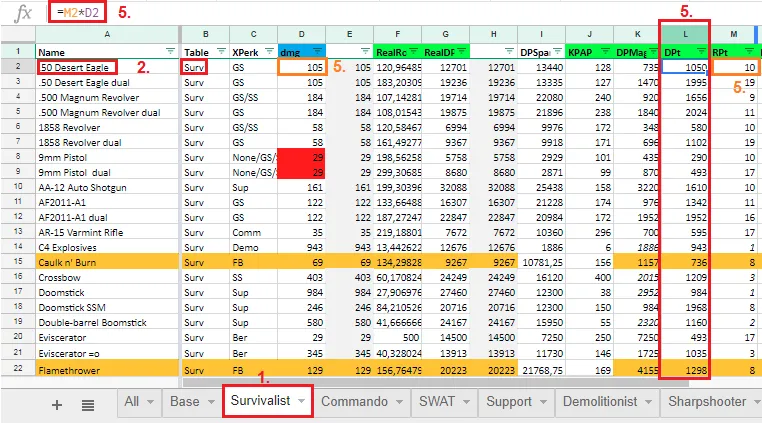 The Survivalist tab with call-outs: 1 the tab, 2 the weapon name, 3 the table, 5 the column and its formula.
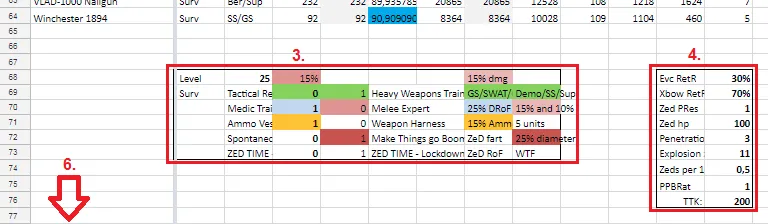 The input modules (perk, coefficient and loadout) next to the main table.
How to enter values
- Everything meant for user input is in bold.
- The sheet accepts nearly any value without warning, so stay within realistic ranges (perk level 0 to 25, for instance). If you do not understand a field, leave it alone at first.
- Logic fields take 0 (false) or 1 (true). Two exceptions carry several values in one cell: Rack 'Em Up (bool talent, int headshot count) and the buy prices for 9mm and tier 1 weapons (int price, bool belongs to tier 1/9mm).
- Sorting works from the arrow beside a column name.
- Combo weapons, dual pistols and weapons with very different fire modes have separate rows. Choosing a dual pistol or a fire mode excludes the matching counterpart from loadout comparisons, whereas combo weapons are not excluded.
- To put a weapon in the loadout module, click the row number to highlight the whole row, copy it, then paste it into an empty slot. To empty a slot, highlight the row and press Delete.
Main table columns
| Field | Meaning |
|---|---|
| Name, Table | Weapon name and the table the row comes from |
| XPerk (Crossperk) | Which other perk tables the gun should be listed in |
| DMG1 / DMG2 | Current damage / potential damage (headshot, leg or arm damage, Rack 'Em Up bonus) |
| RealRoF | Real rate of fire: delay between shots combined with the time to reload a single bullet |
| RealDPM | Real damage per minute for DMG1 and DMG2 |
| DPSpare | DMG1 multiplied by total ammo |
| KPAP | Kills per ammo penetration, a rough estimate of total kills |
| DPMag | DMG2 multiplied by magazine size |
| DPt, RPt | Damage per t and rounds per t (the TTK window); reload time is ignored unless every shot needs a reload |
| DPM | DMG1 and DMG2 multiplied by RoF |
| Mag, PPMag | Modified magazine size and its price |
| PPBRatio, PPBx | Price per bullet ratio; money equivalent of ammo from one ammo box |
| SupPrice, SupMag | Money equivalent and magazines gained from a Support interaction |
| PuR | Pickup rate modifier for ammo per box |
| Bx2Weight eff, Sup2Weight eff | Box price or support price divided by weapon weight |
| ReltPBF, ReltPBC | Reload time per bullet for the full and for the cut (cancelled) reload |
| RelF, RelC, delta | Full reload time, cut reload time and the time saved by cutting |
| TotAmmo | Modified magazine plus modified spare ammunition |
| Penetration | Collateral potential, capped by realistic penetration or explosion kills |
Original values, coefficients, loadout and perk modules
- Original values: buy price (halved for combo weapons), reload times (including elite reload), unmodified RoF, magazine size and cost, base DMG for one pellet or bullet, explosion damage, pellets, total ammo, initial magazines, weight (halved for combo weapons), penetration or explosion radius, dart rate and charge values, tier upgrade damage modifiers, weight increases, upgrade prices and medic charge modifiers.
- Coefficient module: Eviscerator blade and crossbow bolt retrieval rates, target ZED penetration resistance and HP, limits on ZEDs penetrated or killed by an explosion, ZED density per 100 units, the price-per-bullet ratio, and the time-to-kill value used for RPt.
- Loadout module: number of times a weapon is upgraded (0 to 9) and whether tier 1 weapons were picked up, spawned with or bought.
- Perk module: perk level, which perk talents are chosen, and the Rack 'Em Up headshot counter (input 0 to 4; at 5 the DMG2 calculation becomes faulty).
- Reloading time tables were listed as under construction.
Reading the trade-off formulas
The author uses a small notation to show how stats influence each other, for example:
- more initial magazines means more magazines you can gain from supports;
- faster reload raises rate of fire and survivability;
- bigger magazines lower the reload time per bullet and raise ammo gained per box, but hurt survivability;
- more damage means fewer bullets needed per kill, but usually a worse economy;
- a tier upgrade adds damage, dart rate of fire and explosion radius but costs money and weight;
- dual wielding raises rate of fire, magazine and reload value but loses one initial magazine and does not raise box pickup rate.
The author warns not to read these as exact equivalences: a 10% damage increase is not exactly a 10% bigger magazine.
Known issues and plans
- Elite reload for the AR-15 and the reload counter of the Rail Gun needed fixing.
- DBB and akimbo reload times, and damage over time for fire and toxic weapons, were not fully accurate.
- Sharpshooter damage handling and the 7-pellet limit were not fully understood.
- Gunslinger and Commando should get a bonus to weapon switching rate.
- Tier damage modifiers were applied in the wrong order, giving rounding errors of a few points.
- Planned: colour coding explanation, automatic weapon and loadout grading, reload-cancelling viability, a Fleshpound and Scrake viability table for all upgrade tiers, and guides for Survivalist and other perks.
The author's sources were the Tripwire KF2 wiki, community stats and reload spreadsheets and an older Steam guide.
Comments
The author updated the sheet to v1.081 (adding a one-hit-kill, decapitation and one-hit-headshot-kill table) and later to v1.090. Charge level calculation for the Husk Cannon and Killerwatt was added. The author notes that the sheet lags a few versions behind the game.
See also: Weapon type resistances by ZED and Weapon upgrade system explained.
FAQ
- What is RealDPM in this spreadsheet?
- Real damage per minute that includes reloading. The author gives the formulas: RealDPM = RealRoF x DMG, RealRoF = 60 / (ReltPBC + 60 / RoF) and ReltPBC = RelC / Mag.
- What does KPAP mean?
- Kills per ammo penetration, a rough estimate of total kills calculated by multiplying total ammo by a modified penetration value.
- Can I type any value into the input cells?
- The sheet accepts almost anything and rarely shows an error, so you must enter sensible numbers (for example a perk level from 0 to 25). Logic fields use 0 for false and 1 for true.